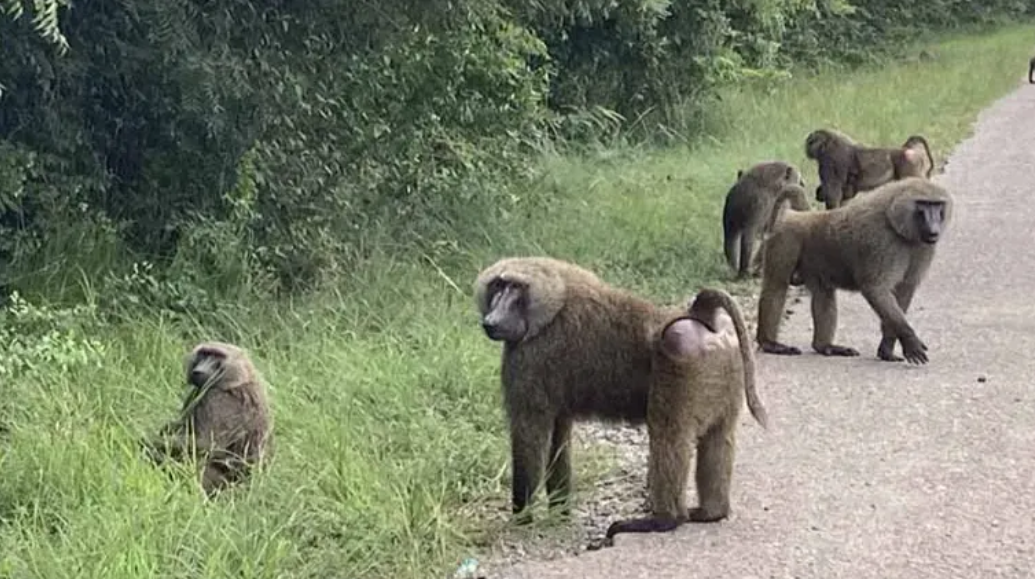
Shai Hills Resource Reserve has always offered a unique window into Ghana’s natural heritage. Located just outside Accra, it is one of the few places where wildlife, culture, and tourism intersect so closely with urban life and a busy highway. But behind its beauty, a growing crisis is unfolding. Increasingly, baboons and green monkeys are leaving the sanctuary, roaming onto the roadside, approaching vehicles for food, and even entering nearby communities. What was once a controlled conservation environment is now becoming a hotspot for human–wildlife conflict, raising questions about ecological imbalance and management gaps.
Several recent visits to the reserve paint a worrying picture. Motorists and commuters driving along the Shai Hills road report unusually large numbers of baboons gathering near the roadside and crossing unpredictably between moving vehicles. Others describe monkeys aggressively snatching food, surrounding tourists, or grabbing items from their hands. In one incident, a monkey seized a visitor’s bowl of food, leaving the group startled and cautious. These behaviours are not typical of healthy primate populations. They suggest a deeper behavioural shift driven by human feeding, population pressure, and reduced fear of people.
Tour guides at the reserve confirm that Shai Hills hosts two main primate species, the baboons and the green monkeys. But the dynamics between them are changing. According to staff, the green monkeys are becoming fewer and more timid because of the growing dominance of the baboons. This imbalance is significant. When one species overwhelms another, it signals that the environment may no longer be supporting biodiversity in a balanced way. It also raises questions about whether the reserve is experiencing overpopulation of larger primates and whether their habitat is shrinking or being disturbed.
The danger is not only ecological. The safety risks are increasing. Drivers along the Shai Hills stretch often encounter baboons sitting by the roadside, moving between cars, or attempting to approach vehicles. Sudden braking or swerving to avoid hitting the animals can lead to accidents. Although there has been no publicly confirmed news report of a recent monkey-related accident, the behaviour patterns observed at the reserve are consistent with high-risk conditions. The National Road Safety Authority advises motorists to drive cautiously in areas where wildlife is present, especially at dawn and dusk when animals are most active, and to observe all road safety regulations to prevent collisions or injuries.
Equally concerning is the growing habit of visitors feeding the animals. Once primates realise that humans provide food, they begin to abandon natural foraging behaviours and become increasingly aggressive, dependent, or bold. This behavioural shift exposes them to food poisoning, malnutrition, and the risk of disease transmission. It also puts visitors in harm’s way because food-conditioned animals lose their natural boundaries and approach people far more closely than they should. As the simple warning goes, “A fed animal is a dead animal.” The message is clear: feeding wildlife creates harmful behaviours, fuels conflict, and ultimately leads to higher mortality for the animals.
The situation is further complicated by the fact that some monkeys now venture into neighbouring communities. Residents occasionally report animals entering compounds or scavenging for food. These incursions heighten tension and increase the likelihood of retaliation, which threatens both conservation efforts and animal welfare. If left unaddressed, this conflict will escalate, and the reserve could lose the ecological stability it needs to function as a sanctuary.
Addressing this complex situation requires a combination of scientific management, community involvement, and nature-based interventions. Nature-Based Solutions (NbS) offer practical pathways that work with the ecosystem rather than against it. One essential approach is habitat restoration within the reserve. Expanding native vegetation, improving food availability, and restoring degraded patches can reduce the animals’ reliance on human food and encourage natural foraging. Another NbS intervention involves creating buffer zones of woody vegetation between the sanctuary and surrounding communities. These green barriers help redirect wildlife movement, reduce human–animal contact, and provide additional feeding grounds.
A third NbS-centered solution is the development of ecological corridors that allow smaller species such as green monkeys to move and forage safely away from dominant baboon territories. Well-designed corridors restore balance, reduce competition, and support biodiversity. These nature-based strategies must be complemented by practical conservation management. Authorities should conduct population assessments to determine whether baboon numbers exceed the carrying capacity of the reserve. If necessary, strategic relocation or habitat expansion may be required. Strict no-feeding rules must be enforced through signage, ranger patrols, and visitor education. Structured awareness campaigns should explain the risks of feeding or approaching wildlife, emphasizing both human safety and animal welfare.
The government also has a crucial role to play. The Forestry Commission, Wildlife Division, Ministry of Lands and Natural Resources, and Ministry of Tourism must collaborate on a sustainable management plan for Shai Hills. This should include investment in wildlife crossings or fencing to reduce road conflict, funding for habitat restoration, and a review of eco-tourism practices to ensure they priorities conservation rather than entertainment. Community engagement is equally essential. Local residents should be part of monitoring, reporting, and stewardship efforts so that protection of the reserve becomes a shared responsibility.
Shai Hills remains one of Ghana’s most important and accessible conservation sites, but it is approaching a turning point. Without timely action, the behavioural changes emerging among the monkey populations will undermine both visitor safety and ecological integrity. This is a moment for Ghana to demonstrate how protected areas near urban centres can be managed using nature-based principles that protect wildlife, strengthen ecosystems, and keep communities safe. The solutions exist, and they begin with restoring the balance between humans and the animals that share the landscape with us.
References
Forestry Commission of Ghana. (2021). Wildlife and protected area management guidelines. Accra, Ghana.
National Road Safety Authority. (2023). Road safety guidelines for wildlife zones. NRSA, Accra.
